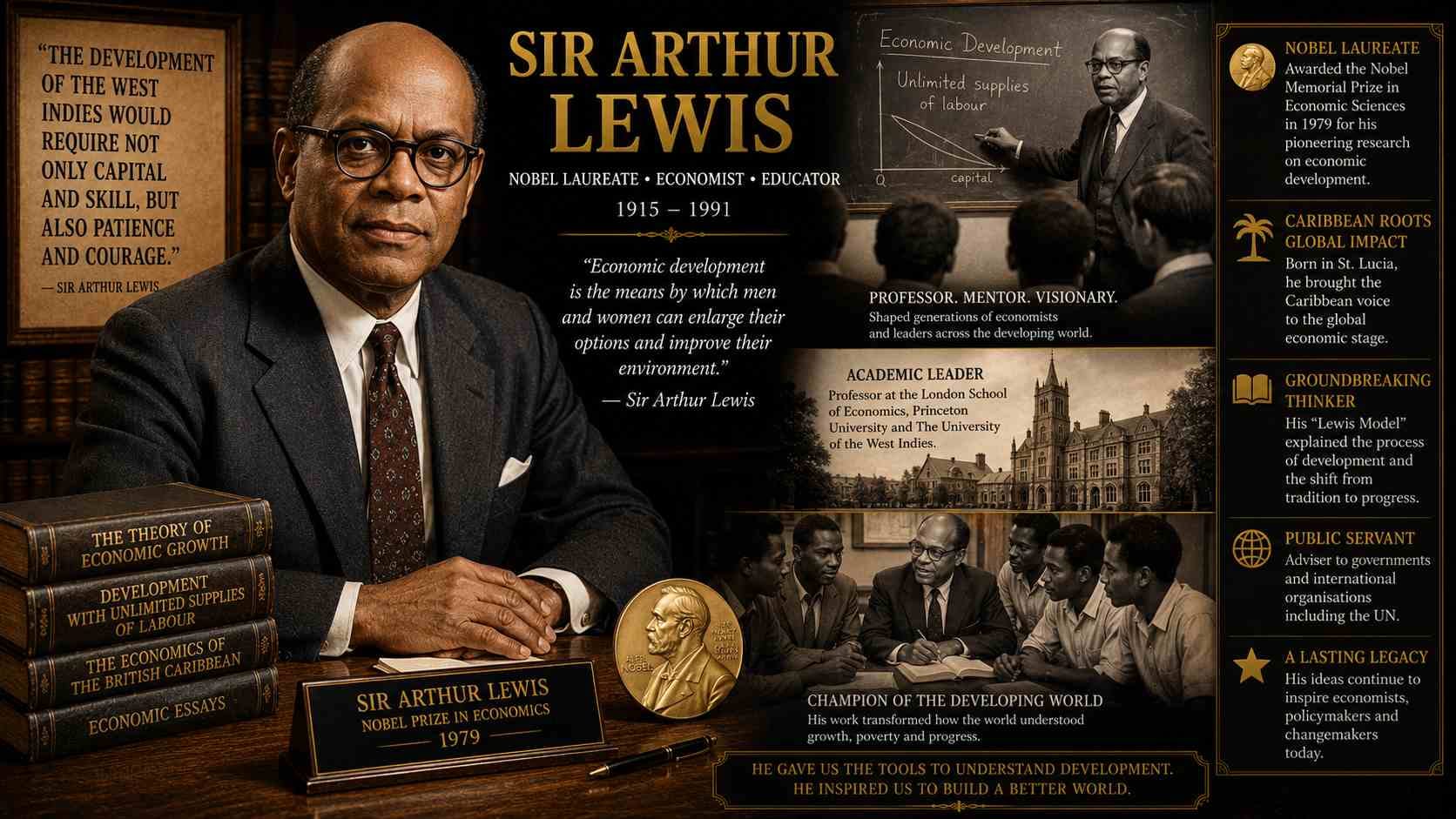
William Arthur Lewis was born on 23 January 1915 in Castries, St Lucia — then a British colony in the Eastern Caribbean. The fourth of five sons, he was educated at St Mary's College in Castries, where his exceptional academic ability became clear. When his father died, Arthur was just seven years old. His mother, Ida, became the defining influence of his life — a woman of remarkable intelligence and determination who instilled in her son a belief that no door was permanently closed to him.
Lewis won a government scholarship to study at the London School of Economics in 1932. He was the first Black student ever admitted to the LSE's undergraduate programme. When he graduated with a first-class degree, he applied for admission to the PhD programme — and was accepted. He completed his doctorate in 1940 and joined the LSE faculty, becoming the institution's first Black lecturer. He later became a professor at the University of Manchester, where he produced the work that would make his name.
In 1954, Lewis published his landmark paper "Economic Development with Unlimited Supplies of Labour" — which became one of the most cited economics papers in history. The Lewis Model explained how developing economies transition from subsistence agriculture to industrial capitalism, providing a theoretical framework that transformed development economics and shaped government policy across the emerging world.
Lewis went on to become Principal of University College of the West Indies (later the University of the West Indies), Vice-Chancellor of the University of the West Indies, and later James Madison Professor of Political Economy at Princeton University. He served as economic adviser to multiple Caribbean governments and was the first President of the Caribbean Development Bank.
In 1979, Sir Arthur Lewis was awarded the Nobel Memorial Prize in Economic Sciences — becoming the first Black person in history to win a Nobel Prize in a category other than Peace. He shared the prize with Theodore Schultz for their work on development economics. He was knighted in 1963. He died on 15 June 1991 in Barbados, aged 76.
- Nobel Memorial Prize in Economic Sciences (1979) — first Black person to win a Nobel Prize outside of Peace
- Knighted by Queen Elizabeth II (1963)
- First Black student and lecturer at the London School of Economics
- Founding President of the Caribbean Development Bank
- James Madison Professor of Political Economy at Princeton University
- Author of the Lewis Model — one of the most cited papers in development economics
- Excellence is the only answer. Lewis entered rooms where no Black person had been before. He survived them not by compromise but by being impossible to ignore.
- Serve your community. Despite his global reputation, Lewis dedicated decades to building Caribbean institutions — the University of the West Indies and the Caribbean Development Bank. Root yourself in where you came from.
- Think for the long term. The Lewis Model was not written for headlines. It was written for history. Do work that outlasts you.
- Open doors behind you. Lewis was the first Black student, first Black lecturer, first Black Nobel laureate. He did not just break through — he held the door open.