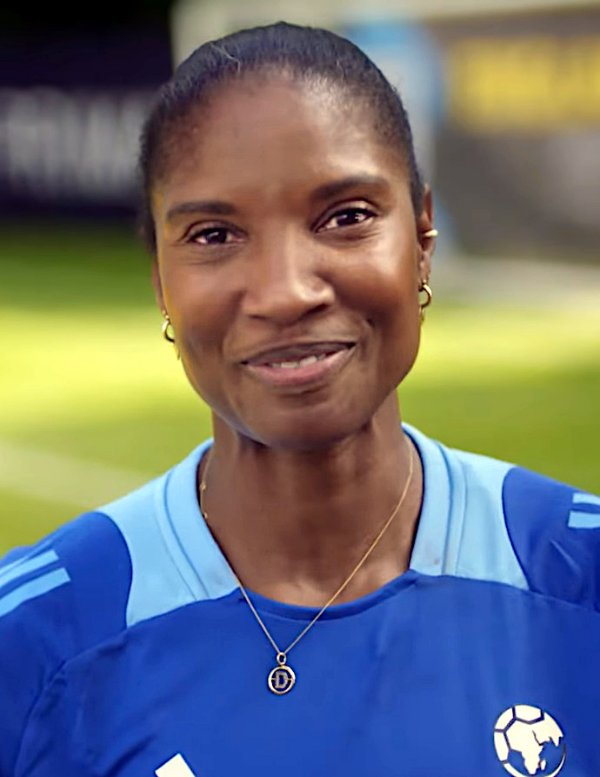
Denise Rosemarie Lewis was born in Wolverhampton in 1972 and began competing in the heptathlon in 1989, though it wasn't until 1994 that she emerged as a genuine contender on the world stage, adding 500 points to her personal best in a single season and defeating Jane Flemming at the Commonwealth Games.
At the 1996 Atlanta Olympics, Lewis recovered from a poor start to win bronze by a margin of just five points, becoming the only British woman to win an athletics medal at those Games. She followed this with silver medals at the 1997 and 1999 World Championships, and heptathlon gold at both the 1998 European Championships and Commonwealth Games.
Lewis's defining achievement came at the 2000 Sydney Olympics, where despite competing through significant injury — an inflamed Achilles tendon, a painful ankle and a damaged foot — she won gold, becoming the first European woman to be crowned Olympic heptathlon champion and Britain's first female multi-event Olympic champion since Mary Peters in 1972. She famously completed the deciding 800m with her injured leg heavily strapped, needing only to stay within ten seconds of her closest rival.
After retiring from competition, Lewis built an extensive broadcasting career with the BBC, commentating on athletics events including multiple Olympic Games. She holds the third-highest heptathlon score in British history and is recognised as an inspiration to the generation of heptathletes who followed her, including Jessica Ennis-Hill, who has directly credited Lewis's Sydney gold with inspiring her own career. Lewis was made a Dame in 2023 and serves as President of Commonwealth Games England.
- Olympic Heptathlon Champion, Sydney 2000 — the first European woman to win the event
- Britain's first female multi-event Olympic champion since Mary Peters in 1972
- Bronze medallist, 1996 Atlanta Olympics, the only British woman to win an athletics medal at those Games
- European Champion (1998) and two-time Commonwealth Games Champion
- Holds the third-highest heptathlon score in British athletics history
- Compete through adversity when the moment demands it. Lewis won Olympic gold in Sydney despite an inflamed Achilles, a painful ankle and a damaged foot, calculating exactly what margin she needed in her final event.
- A hard-fought bronze can be as significant as gold. Her five-point margin bronze at Atlanta 1996 demonstrated resilience that laid the groundwork for her Sydney triumph four years later.
- Be the reference point for those who come after you. Jessica Ennis-Hill has directly credited watching Lewis's Sydney gold as the moment that inspired her own heptathlon career.
- Extend your influence beyond competition. Her long BBC broadcasting career and presidency of Commonwealth Games England have kept her shaping British athletics long after retirement.