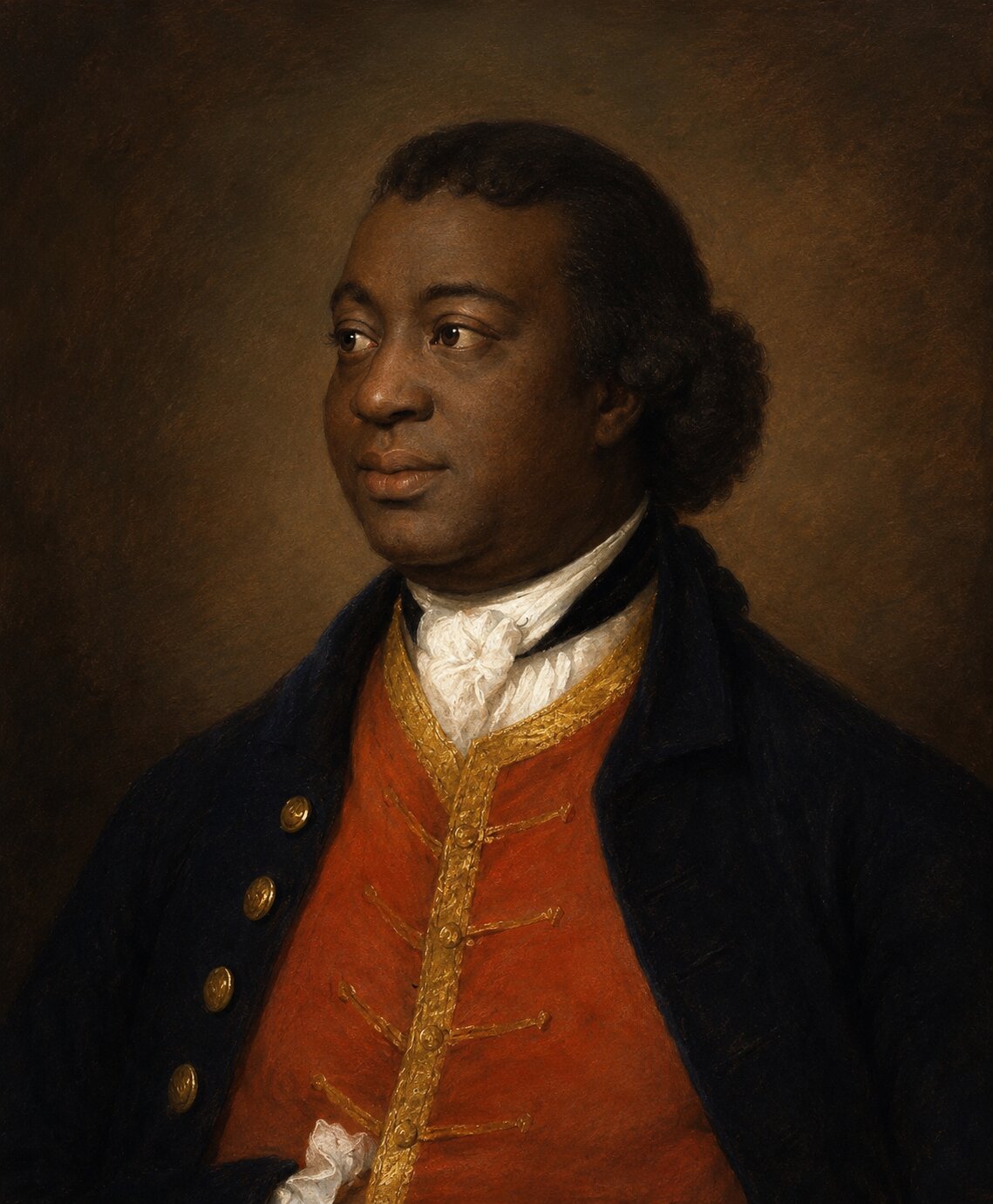
Ignatius Sancho was born around 1729 on a slave ship crossing the Atlantic. His mother died shortly after his birth and his father took his own life rather than live in slavery. The infant Sancho was taken to Greenwich, England, where he was given as a gift to three sisters who named him Ignatius Sancho — a name combining religious reference with a comic literary allusion.
The sisters, who believed that educating a Black person was dangerous and unnecessary, nevertheless found themselves unable to prevent the young Sancho from educating himself. He was befriended by the Duke of Montagu, who lent him books and encouraged his remarkable intellect. When the Duke died, his widow took Sancho into her household as a butler.
Sancho became one of the most celebrated figures in 18th-century London. He was a composer, writing music for theatre and publishing his own works. He was a writer of letters — his collected correspondence, published after his death, became a bestseller and went through five editions. He was a friend of Laurence Sterne, David Garrick and other leading figures of the age.
In 1774, Sancho opened a grocery shop in Westminster with his wife Anne. The shop became a meeting place for artists, writers and intellectuals. And in 1774, because he was a property-owning householder, Sancho became the first Black person to vote in a British election — casting his vote in the Westminster constituency.
Ignatius Sancho died on 14 December 1780, suffering from gout — a condition brought on by his love of food and drink, which he freely admitted. His Letters of the Late Ignatius Sancho, an African, published posthumously in 1782, was one of the first works by a Black author to be widely read in Britain and helped fuel the abolitionist movement.
- First Black person to vote in a British election (1774)
- First Black British composer to have his music published
- His posthumous Letters went through five editions — a bestseller of the era
- Friend and correspondent of Laurence Sterne, David Garrick and other leading cultural figures
- His portrait by Thomas Gainsborough is one of the most celebrated images of a Black person in 18th-century art
- His letters were used as evidence by abolitionists to argue for the humanity and intelligence of Black people
- Educate yourself by any means necessary.. Sancho's owners refused to educate him. He educated himself using borrowed books. The will to learn cannot be suppressed.
- Culture is influence.. Sancho used music, literature and conversation to build relationships with the most powerful people in London. Soft power is real power.
- Exercise every right available to you.. When Sancho was eligible to vote, he voted. Civic participation is both a right and a responsibility.
- Leave a paper trail.. His published letters became his legacy. Written words outlive the person who wrote them.