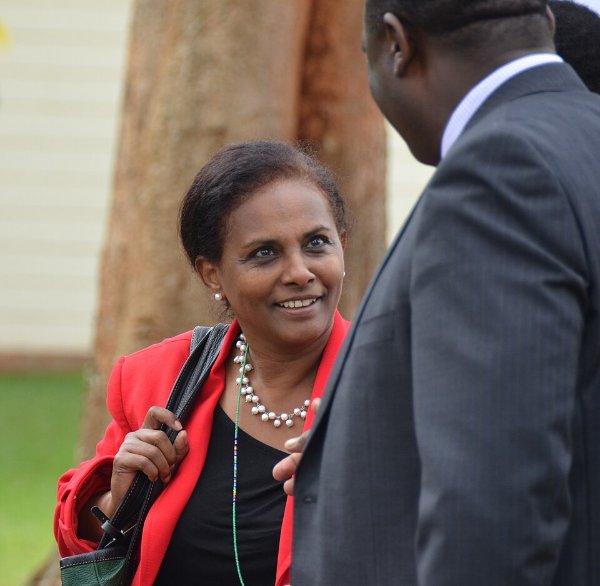
Segenet Kelemu was born in 1957 in the village of Finote Selam, in Ethiopia's Gojjam region, where, like other children in her community, she was expected to help with the back-breaking labour of farming and witnessed firsthand the devastating impact of a locust plague on her village's crops and food security.
In 1974 Kelemu became the first woman from her region to attend university, earning a BSc in plant sciences from Addis Ababa University before moving to the United States, where she completed a Master's in Genetics at Montana State University and a PhD in molecular plant pathology at Kansas State University in 1989.
After postdoctoral research at Cornell University, Kelemu worked at the International Center for Tropical Agriculture in Colombia from 1992 to 2007, focusing on the molecular determinants of host-pathogen interactions and developing novel strategies for controlling plant disease.
Kelemu went on to lead the International Livestock Research Institute's biosciences programme before becoming Director General and CEO of the International Centre of Insect Physiology and Ecology, known as icipe, in Nairobi, Kenya, from November 2013 to December 2023, where her leadership drove sustainable development and food security initiatives across more than 40 African countries.
Kelemu has received the World Academy of Sciences Prize for Agricultural Sciences, the L'Oréal-UNESCO Award for Women in Science, and was named to Doha Debates' SolvingIt series as a role model for women in science; in 2022 Ethiopia's Enat Bank named its 94th branch after her in honour of her scientific excellence.
- Director General and CEO of the International Centre of Insect Physiology and Ecology (icipe), 2013–2023
- First woman from her region of Ethiopia to attend university
- Received the World Academy of Sciences Prize for Agricultural Sciences
- Received the L'Oréal-UNESCO Award for Women in Science, 2014
- Led food security and sustainable development initiatives across more than 40 African countries
- Witnessing hardship firsthand can shape a life's scientific mission. Kelemu's childhood memory of a locust plague devastating her village's crops directly shaped her lifelong focus on plant pathology and food security.
- Breaking a barrier can open doors for an entire region. As the first woman from her region to attend university, Kelemu's path paved the way for recognition of women in African science more broadly.