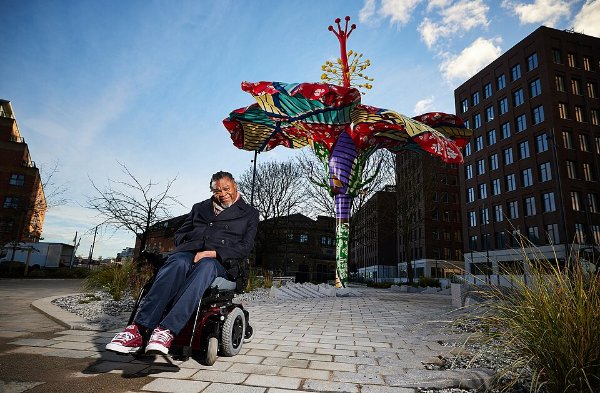
Yinka Shonibare was born on 9 August 1962 in London to Nigerian parents and moved to Lagos, Nigeria, at age three, returning to Britain to study Fine Art at the Byam Shaw School of Art before completing his MFA at Goldsmiths, University of London, graduating alongside the generation of Young British Artists.
Shonibare is paralysed on one side of his body following an illness in his twenties, and works with the assistance of studio assistants who help realise his sculptures, paintings, photography, film and large-scale installations under his direction.
Shonibare's signature practice uses brightly patterned 'Dutch wax' batik fabric, manufactured by the Dutch based on Indonesian designs and sold throughout West Africa, as a material lens for exploring the complex, intertwined legacies of colonialism, trade and cultural identity.
In 2004 Shonibare was nominated for the Turner Prize and appointed MBE, and in 2010 his sculpture Nelson's Ship in a Bottle, recreating Admiral Nelson's flagship with sails made from his signature African fabric, was displayed on the Fourth Plinth in Trafalgar Square before entering the permanent collection of the National Maritime Museum, Greenwich.
Shonibare was elected a Royal Academician in 2013, awarded the CBE in 2019, and has continued exhibiting internationally, including a major solo exhibition at the Serpentine Gallery, London, in 2024 and his first major African showcase at Fondation H, Madagascar, in 2025.
- Nelson's Ship in a Bottle displayed on Trafalgar Square's Fourth Plinth, 2010, now in the National Maritime Museum
- Turner Prize nominee, 2004
- Elected Royal Academician, 2013
- Exhibited at the Venice Biennale, Documenta, and major museums worldwide
- First major solo exhibition on the African continent, Fondation H, Madagascar, 2025
- A material can become an entire artistic signature. Shonibare's use of Dutch wax fabric, itself a product of complex colonial trade history, became the defining visual element of his work.
- Physical limitation does not have to limit creative output. Despite being paralysed on one side of his body, Shonibare has continued producing ambitious large-scale sculptures and installations by directing skilled studio assistants.